Ego Free Leadership by Brandon Black & Shayne Hughes
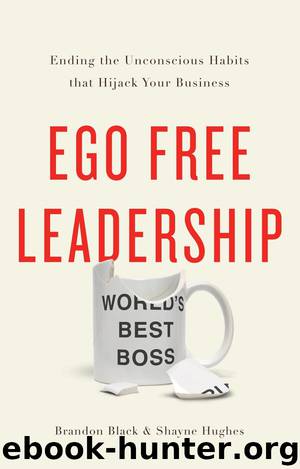
Author:Brandon Black & Shayne Hughes
Language: eng
Format: epub
ISBN: 9781626343801
Publisher: Greenleaf Book Group Press
Published: 2017-03-18T04:00:00+00:00
1.Name the dynamic together rather than blame one another. Here are three practical ways to keep your team focused on the problem, not the imperfect people trying to solve it:
•Avoid inflammatory and judgmental language. Express your observations, not your conclusions. Rather than use words like “never” or “always,” or make blanket statements to emphasize your frustration, briefly, clearly state what you see. This moves the conversation away from character assassination and toward observable behavior.
•Describe the reinforcing communication loop you create together. When someone simply states, “this is what is playing out between us” rather than “this is what you are doing to me,” it helps everyone see that each side’s judgments are often mirror images of the other.
•Recognize your impulse to be right. Your analysis of any situation is a collage of beliefs, not fact, and is always incomplete and biased. By proactively questioning your conclusions, your perspective can expand to include a more accurate picture of reality.
2.Identify your ego threats and communicate them with vulnerability. Most of us have a major blind spot in our professional and personal relationships: Our fear of others’ judgment thwarts us from realizing that others feel just as afraid as we do. Disclosing your fears vulnerably to others shatters this facade.
Although this can feel uncomfortable, these anxieties are only potent when we keep them to ourselves. Expressed collectively, our fears dissipate. Time and again, I have witnessed the majority of the tension in a room vanish when a team member—particularly a leader—frankly admits his or her fear of being judged. A reinforcing cycle of mutual empathy replaces the downward spiral of mutual judgment.
3.Acknowledge the consequences of your Us vs. Them dysfunction. When we are caught up in our Us vs. Them dynamics, our frustrations with the other side lead us to ignore the damage we are causing with our gridlock and accusations. The IC team named close to thirty discrete costs, such as “missed growth/profit goals”; “make bad decisions because we’re not objective”; “I don’t want to work here unless this changes”; “I’m failing other people in this company by not contributing to our success.” Confronting the brutal truth of their dysfunctional interactions was a rude shock. When we acknowledge, on an emotional level, the consequences of our behavior, it inspires us to challenge our certainties about the conflict.
4.Seek to understand how you are contributing to the problem. Another classic symptom of Us vs. Them dynamics is that we view ourselves as the well-intended, competent party and the others as the problem. This is almost universally untrue.
Shifting these dynamics requires challenging both biases. Where is our side not as perfect as we profess? What valuable contribution and valid perspective are we dismissing from the other group? What is true about their frustrations with us? Are we blaming them for something that is a mutual or company-wide problem?
By talking openly about your biases, it becomes easier to trust another group’s input as a “net balanced view’” coming from a different perspective. Of course, it works much better when both sides are committed to transparently questioning their assumptions.
Download
This site does not store any files on its server. We only index and link to content provided by other sites. Please contact the content providers to delete copyright contents if any and email us, we'll remove relevant links or contents immediately.
Hit Refresh by Satya Nadella(9101)
The Compound Effect by Darren Hardy(8901)
Change Your Questions, Change Your Life by Marilee Adams(7715)
Nudge - Improving Decisions about Health, Wealth, and Happiness by Thaler Sunstein(7676)
The Black Swan by Nassim Nicholas Taleb(7085)
Deep Work by Cal Newport(7028)
Rich Dad Poor Dad by Robert T. Kiyosaki(6568)
Daring Greatly by Brene Brown(6485)
Principles: Life and Work by Ray Dalio(6369)
Playing to Win_ How Strategy Really Works by A.G. Lafley & Roger L. Martin(6168)
Man-made Catastrophes and Risk Information Concealment by Dmitry Chernov & Didier Sornette(5977)
Digital Minimalism by Cal Newport;(5733)
Big Magic: Creative Living Beyond Fear by Elizabeth Gilbert(5721)
The Myth of the Strong Leader by Archie Brown(5479)
The Slight Edge by Jeff Olson(5391)
Discipline Equals Freedom by Jocko Willink(5351)
The Motivation Myth by Jeff Haden(5188)
The Laws of Human Nature by Robert Greene(5126)
Stone's Rules by Roger Stone(5065)
